
Sunday, March 20, 2016
Ways to...wait for it...PREVENT allergies???

Sunday, January 10, 2016
Bon voyage! Travel fearlessly.
As winter break just ended and with President's Week around the corner, I was reminded of precautions to take when you go to another country.
1. Be prepared for non-English speakers
Oftentimes vendors and servers don't understand what "nuts," "sesame," or other things mean. Make sure you know how to say what your allergy is in whatever languages you might be encountering on your trip. When I went to Budapest and Prague last year, I carried around a notecard with my allergies listed in English, Hungarian and Czech. Although for the most part they understood the words in English, many locals did not know what "sesame was," hence the card came in handy.
2. Before the flight
It's also a good idea to inform your airline in advance of your allergy so they can prepare a special allergy-free meal just for you. Even vegetarians and gluten-free people can do this! They will have your seat number and will know what foods are okay to give you.
3. Back-up fuel
You should bring your own snacks just in case the food around you is unreliable at times. In Europe, most desserts and snacks have nuts in them, so I thrived off of Fiber One bars, Craisins, cheese sticks, and easy mac n' cheese.
It's important to be careful if you're not familiar with the local cuisine because you never know what hidden ingredients there may be!
Happy travels :)

1. Be prepared for non-English speakers
Oftentimes vendors and servers don't understand what "nuts," "sesame," or other things mean. Make sure you know how to say what your allergy is in whatever languages you might be encountering on your trip. When I went to Budapest and Prague last year, I carried around a notecard with my allergies listed in English, Hungarian and Czech. Although for the most part they understood the words in English, many locals did not know what "sesame was," hence the card came in handy.
2. Before the flight
It's also a good idea to inform your airline in advance of your allergy so they can prepare a special allergy-free meal just for you. Even vegetarians and gluten-free people can do this! They will have your seat number and will know what foods are okay to give you.
3. Back-up fuel
You should bring your own snacks just in case the food around you is unreliable at times. In Europe, most desserts and snacks have nuts in them, so I thrived off of Fiber One bars, Craisins, cheese sticks, and easy mac n' cheese.
It's important to be careful if you're not familiar with the local cuisine because you never know what hidden ingredients there may be!
Happy travels :)

Sunday, November 29, 2015
The line to remain uncrossed
There's a line between being careful and being downright mean.
When I was in elementary school, many people crossed to the mean side. I was instructed by teachers to sit at the designated "peanut allergy table," which was supposed to make me feel more comfortable and less at risk, but it just made me feel isolated and miserable. I switched back to my normal classroom table. Also, sometimes kids would tease me and shove Nutella in my face. This is not okay at all because it actually both physically and mentally bothered me (the smell made me nauseous). People should be respectful and cautious, but not to the extent that it's exclusive. Like I've said in other blogs, we allergy people aren't allergic to the subject. We don't need to be discriminated against because we have allergies either. Of course, not everyone realizes this and won't follow this perfectly. Don't let it get you down! You're not worse than anyone else because of your allergy. You're different. You're YOU and that's okay! :)
Careful
Line: ---------------------
Mean
When I was in elementary school, many people crossed to the mean side. I was instructed by teachers to sit at the designated "peanut allergy table," which was supposed to make me feel more comfortable and less at risk, but it just made me feel isolated and miserable. I switched back to my normal classroom table. Also, sometimes kids would tease me and shove Nutella in my face. This is not okay at all because it actually both physically and mentally bothered me (the smell made me nauseous). People should be respectful and cautious, but not to the extent that it's exclusive. Like I've said in other blogs, we allergy people aren't allergic to the subject. We don't need to be discriminated against because we have allergies either. Of course, not everyone realizes this and won't follow this perfectly. Don't let it get you down! You're not worse than anyone else because of your allergy. You're different. You're YOU and that's okay! :)
Careful
Line: ---------------------
Mean
Thursday, November 12, 2015
Fake Allergies
Have you ever gotten an itchy throat from eating a fruit? Let's say, an apple. Or a strawberry. Or maybe even a grape. During my entire early childhood I thought I was allergic to apple skins because sometimes they made my throat itchy, so my mom peeled them off for me. The same itchiness has happened to me with other fruits.
 I was wrong! What actually was bothering me was that the protein in the fruit has a similar protein to the trees, weeds and grasses of my hay fever allergy. Some people even say that there is some pollen on the fruit. If you have seasonal allergies like me, this has probably happened to you or will happen at some point. Have no fear! It's totally normal. And the symptoms don't usually last long. It may not bother you when the season changes so you can eat with comfort then. Or if the fruit is cooked, you should have no problem.
Don't get tricked by that sneaky pollen-food allergy! You're good to go.
Thursday, November 5, 2015
Am I having an allergic reaction?
Symptoms:
- Itchy throat
- Hives
- Slight nauseia
- Extreme nauseia, vomiting
- Heartburn
- Having trouble breathing
- Having trouble swallowing
The blue symptoms are minor reactions, whereas the red symptoms are the more dangerous warnings.
If you're having a blue symptom you can take an allergy pill like Benadryl or ignore it.
If you're having a red symptom, then it's more serious and you should definitely take Benadryl. If you have trouble breathing or swallowing, that's where an adrenaline auto injector like "EpiPen" comes into play.

Thursday, October 8, 2015
Separate but Equal
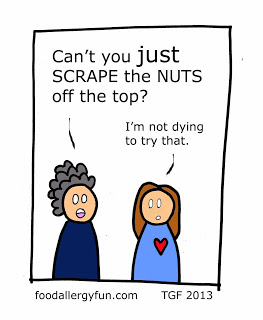 A common mistake is that people think that if the thing they're allergic to isn't an ingredient in their food, they won't have a reaction. But sometimes if it's in the same box as the thing they're allergic to, they can still have a reaction.
 One time my aunt put cookies that had nuts in them in the same box as a cookie that I ate (that didn't have nuts), and I had a reaction.
 This is why it's important to keep the foods separate but equal. You can still have your delicious food, but without it touching the things you're allergic to.
Thursday, October 1, 2015
Always expect the unexpected
ALWAYS ASK restaurants, bakers, cooks, etc. if the food you're getting contains your allergen. This could seem odd, but trust me, sometimes foods include weird ingredients.
For example, I've encountered a bakery that used almond paste for ALL of its baked goods, including bread. Also, many restaurants use peanut and sesame oil to cook their foods (including burgers)! In other countries and in foreign foods (that are even sold in America) they use different names for the same foods. You need to make sure that you know the different names for your allergen. For example, my mom cooked a ravioli that had an ingredient called "pinoli" in its sauce that actually meant "pine nut," but my mom didn't know that and assumed it was fine. IF YOU DON'T KNOW IT, LOOK IT UP. Don't take the risk. It never hurts to ask!
For example, I've encountered a bakery that used almond paste for ALL of its baked goods, including bread. Also, many restaurants use peanut and sesame oil to cook their foods (including burgers)! In other countries and in foreign foods (that are even sold in America) they use different names for the same foods. You need to make sure that you know the different names for your allergen. For example, my mom cooked a ravioli that had an ingredient called "pinoli" in its sauce that actually meant "pine nut," but my mom didn't know that and assumed it was fine. IF YOU DON'T KNOW IT, LOOK IT UP. Don't take the risk. It never hurts to ask!
Subscribe to:
Posts (Atom)